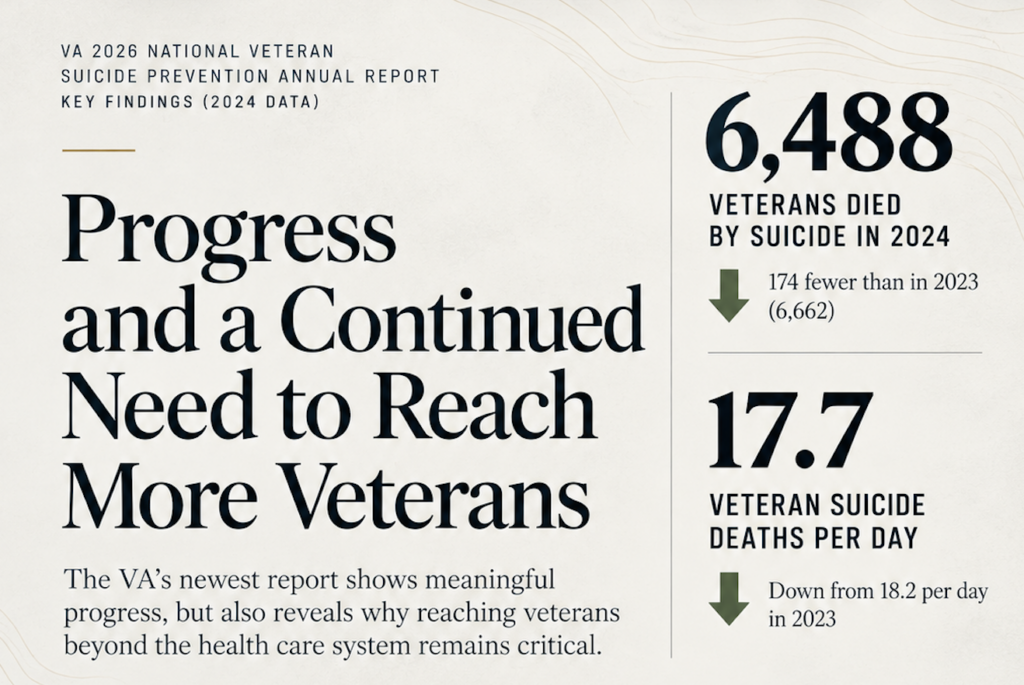
The VA’s newest Suicide Prevention Report shows meaningful progress, but also reveals why reaching veterans beyond the health care system remains critical.
By Kerry Irvin, CEO Operation Healing Forces
The Department of Veterans Affairs’ newest report on veteran suicide contains an important measure of progress, but also a warning about where we are still failing to reach veterans.
According to the newly updated data, 6,488 veterans died by suicide in 2024, 174 fewer than the revised total of 6,662 in 2023. The average number of veteran suicide deaths declined from 18.2 to 17.7 per day.
Every decline matters. But 17.7 deaths a day is not a number that allows any of us working in this space to ease up.
Beneath that overall decline is a troubling divide.
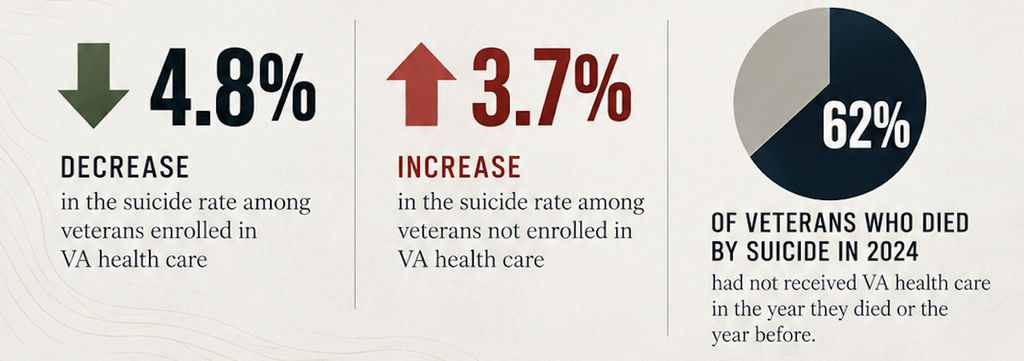
From 2023 to 2024, the suicide rate among veterans enrolled in Veterans Health Administration care fell 4.8%.
Among veterans who were not enrolled, the suicide rate rose 3.7%. And 62% of veterans who died by suicide in 2024 had not received VA health care in the year they died or the year before.
Those numbers should change the way we think about veteran suicide prevention.
We cannot build a national prevention strategy that depends on veterans finding their way through the doors of a health care system before we find our way to them.
We must work to reach veterans where they are.
Suicide risk does not exist in isolation
The VA’s own analysis helps explain why.
As part of the 2026 report, VA suicide-prevention teams reviewed the deaths of nearly 3,000 recent VHA users who died by suicide between 2022 and 2024.
Among the most frequently documented risk factors in the year before their deaths were pain, sleep problems, worsening health, declining physical ability, relationship problems, hopelessness and financial loss.
The report also identified legal problems, risk of homelessness, alienation and feeling like a burden to others.
Think about what those factors look like in someone’s actual life.
A marriage under tremendous strain. A family facing an unexpected financial crisis. Chronic pain or declining health. Difficulty paying for housing or basic needs. Isolation. A transition that has stripped away the identity, community or sense of purpose someone once relied upon.
These challenges do not exist neatly within the walls of a mental health clinic. They happen in homes, marriages, bank accounts, workplaces and communities.
And that is precisely where organizations like Operation Healing Forces can make a difference.
This is what prevention can look like in a community
At Operation Healing Forces, we serve wounded, ill, injured and fallen members of the Special Operations Forces community, including service members, veterans, families, caregivers and survivors.
Much of that work occurs long before someone identifies what they are experiencing as a mental health crisis.
- When a family is facing financial hardship, we can help stabilize an immediate need.
- When a couple has been strained by years of deployments, injuries, caregiving or transition, our therapeutic retreats create space to reconnect.
- When someone needs mental or behavioral health support, we can help connect them to care.
- When a service member or veteran is navigating transition, we can help provide resources and pathways toward greater stability and a sense of purpose.
- And when someone feels increasingly isolated, we work to restore something extraordinarily important: connection.
These services are not substitutes for clinical mental health care, nor would we claim that any individual intervention “prevented a suicide.” Suicide is complex, and the VA report itself cautions against drawing causal conclusions from these data.
But the report also reinforces why this work matters.
Suicide prevention can begin long before someone is in crisis.
Sometimes the first request for help is not, “I am struggling with my mental health.”
Sometimes it is:
“I can’t pay my rent.”
“My marriage is falling apart.”
“I can’t sleep.”
“I’m chronically in pain.”
“I lost my job.”
“I don’t know what comes next.”
“I feel like nobody else can understand what I’m dealing with.”
Those moments give us an opportunity to respond before multiple pressures compound. They are opportunities to reduce vulnerability, strengthen connection, increase stability and create pathways to additional support when it is needed.
That is why community-based organizations are such an important part of a broader continuum of prevention.
Alongside the VA, not instead of it
This is not an argument for community-based support instead of the VA. It is an argument for community-based support alongside the VA.
The VA has specialized expertise and resources designed to identify and mitigate suicide risk, including screening, evidence-based mental health care, safety planning and specialized suicide-prevention treatment.
Organizations like OHF provide a different but complementary point of connection, particularly for members of the military and veteran community who may not be connected to VA care or whose first need falls outside a clinical setting.
And the longer-term data make the importance of reaching those populations difficult to ignore.
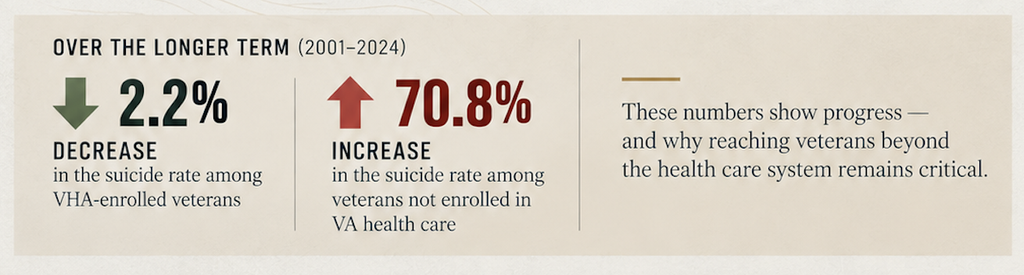
From 2001 through 2024, the suicide rate among VHA-enrolled veterans decreased 2.2%. Among veterans who were not enrolled, it increased 70.8%.
This data reinforces the importance of reaching those who need assistance but may not be connected to the resources and support available to them.
Your support helps us reach them
The decline in veteran suicide deaths in 2024 deserves to be recognized. It represents 174 fewer lives lost than in 2023.
But 6,488 veterans still died by suicide in a single year.
There is no single organization, program or intervention capable of solving this crisis.
What we can do is continue building a stronger network around those who served, one that reduces vulnerabilities, strengthens protective factors and makes it more likely that help is within reach when someone needs it.
That is what your support of Operation Healing Forces makes possible.
It helps us respond when a Special Operations family faces an unexpected financial crisis. It helps couples reconnect after years of sacrifice and strain. It helps veterans and family members access mental and behavioral health resources. It helps people navigate difficult transitions. And it helps ensure that members of this community know there is somewhere to turn before circumstances become overwhelming.
For those who already support OHF, thank you. You are part of that network of protection and connection.
And for those looking for a tangible way to make a difference in the lives of our nation’s Special Operations Forces community, we would be honored to have you join alongside our mission.
Because suicide prevention does not happen in only one place.
Sometimes it happens in a therapist’s office or during a crisis intervention. And sometimes it begins much earlier, when someone helps a veteran find stability, rebuild a relationship, navigate a difficult transition, reconnect with other people or recognize that asking for help is an act of strength.
If the newest data tell us anything, it is that we cannot wait for every veteran to come to us.
We have to be willing to go to them.

Read the Report
The 2026 National Veteran Suicide Prevention Annual Report contains the VA’s latest national data, updated through 2024.
Read the 2026 National Veteran Suicide Prevention Annual Report
If You or Someone You Know Needs Help
Veterans, service members and their loved ones can contact the Veterans Crisis Line 24/7 by calling 988 and pressing 1, texting 838255, or connecting through the Veterans Crisis Line website.